3 Regulatory Mistakes That Keep Coming Up in Biotech
 Written byNeta Kela, PhDFounder & Managing Partner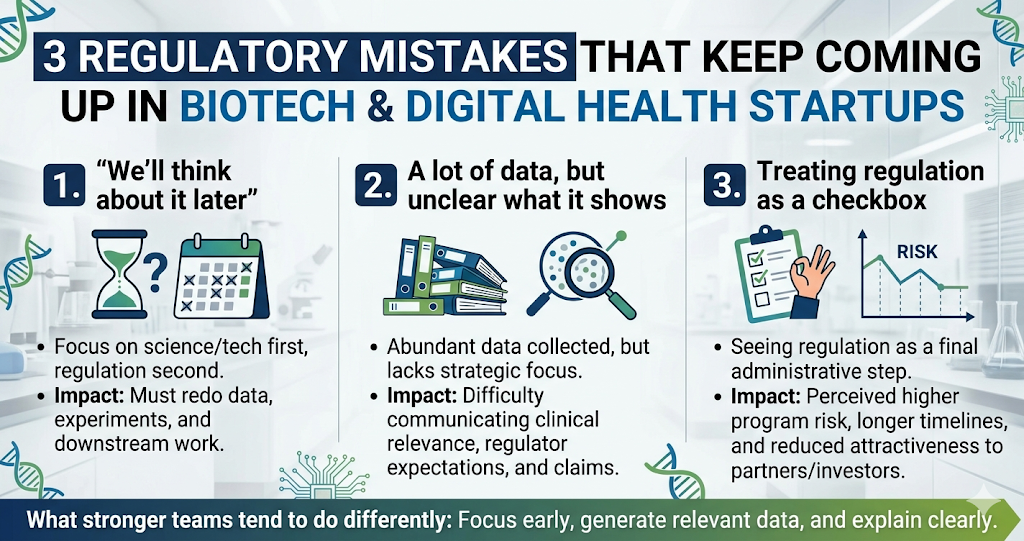
After several recent conversations with biotech and digital health teams, a pattern keeps repeating.
Not around the science — that's usually strong.
It's around regulation.
1. "We'll think about it later"
Completely understandable.
The focus is on proving the biology, building something real, showing traction. Regulation feels like something for later.
But in practice, it affects:
- what data is generated
- how experiments are designed
- what actually matters downstream
Many teams end up doing a lot of work… and then realizing parts of it need to be redone.
2. A lot of data, but unclear what it actually shows
This comes up often.
There is usually a lot of data, but when asking:
- what's the clinical relevance?
- what would regulators expect to see?
- what does this enable you to claim?
…the answers are not always clear.
And that becomes very visible when speaking with pharma or investors.
3. Treating regulation as a checkbox
This is probably the biggest one.
Regulation is often treated as something to "get through" at the end.
But in reality, it shapes how others evaluate the opportunity:
- how realistic the path forward is
- how risky the program is
- how long it may take
If that part isn't clear, it affects how seriously the opportunity is taken.
What stronger teams tend to do differently
They don't overcomplicate it.
They simply think earlier about:
- where they are going from a regulatory perspective
- what data supports that path
- how to explain it clearly
That alone makes a big difference.
At Precise X Med, we help biotech and digital health teams integrate regulatory thinking early — before it becomes an obstacle.
How PXM Helps With This
IND-Enabling Regulatory Strategy
Pre-IND strategy, nonclinical package design, and IND readiness planning.
Biotech Readiness Assessment
A 10 minute diagnostic of your regulatory, CMC, and partnering readiness.
CMC Strategy & Manufacturing Readiness
CMC roadmaps, CDMO selection, comparability strategy, and CMC submissions.
Related
Part of FDA & CMC Readiness. Start from the pillar: Operate practice, FDA Regulatory Readiness, CMC & Manufacturing, FDA Expedited Pathways, EU Regulatory Pathways
What a Clinical Overview Must Contain for an EU Hybrid Application
What the Clinical Overview (Module 2.5) must cover in an EU hybrid application under Article 10(3), how to justify differences from the reference product, and where assessors push back.
Well-Established Use Applications: Building a Bibliographic Clinical Overview That Holds Up
How to build the Clinical Overview for an EU well-established use application under Article 10a: the ten-year test, literature selection, and how to bridge your product to the published evidence.
How to Choose an Independent Clinical Expert for Your EU Dossier
What Article 12 of Directive 2001/83/EC requires from the Clinical and Nonclinical Expert, what to look for when you appoint one, and the questions to ask before they sign.
Get notified when we publish new funding and regulatory guides
Practical guidance on FDA and EMA strategy, CMC readiness, and non-dilutive funding — sent only when there is something worth reading.